WORKFLOW LAB

One repeated workflow. One full day. A reviewable AI work product you can sign your name to.

For tax, accounting, consulting, and professional-services operators. You bring one repeated workflow — a proposal, memo, report, or research pack. We map it, mark where AI assists and where a human reviews, and you leave with a work product you'd defend in front of a client or the partner who signs. If there's no valuable workflow, the answer is no-build.

Book a free Workflow Diagnostic →

Free · short call · no raw client files · Kuan reads your intake personally and emails you a time within one working day.
Already decided? Book a US$500 founder day →

FormatPrivate 1-on-1 Lab day with Kuan · live online
PriceUS$500 founder day · rises once the method and artifacts are locked
OutcomeMapped workflow + review gates + AI-assistance plan · seven editable artifacts
GuaranteeLeave with the artifacts and a concrete next step, or a free 1:1 follow-up / your money back
AfterOptional 1:1 implementation from US$1,500 · no retainers, no platform lock-in
WhoRun personally by Kuan · Claude Certified Architect (Anthropic) · build record at phuaky.com
The detail, if you want it
Why this exists — demos, prompt tips, and ad-hoc ChatGPT don't ship

Real work depends on private documents, templates, precedents, judgment, source-of-truth materials, review standards, output formatting, and confidence that the AI result is not quietly wrong.

Generic AI training teaches features. It does not turn one messy workflow into a reviewable work product. What you keep running into instead: tool demos (a vendor showed up, everyone nodded, nothing shipped), prompt tips (a Slack channel of clever prompts no one trusts on a live client file), and ad-hoc ChatGPT (quietly used, not reviewed, not auditable).

The gap is not awareness. The gap is one real workflow you've actually mapped, reviewed, and trusted enough to keep using. That is what we build in a day.

Who it's for — repeated, high-value work products

Best fit: tax, accounting, consulting, legal, professional services. The common thread is a repeated artifact where accuracy, private context, and review matter — proposal decks, client memos, tax incentive assessments, due diligence notes, research packs, internal status updates.

Solo operators and SME owners included: the Lab is scoped per workflow, not per headcount.

The method — the AI Workflow Map

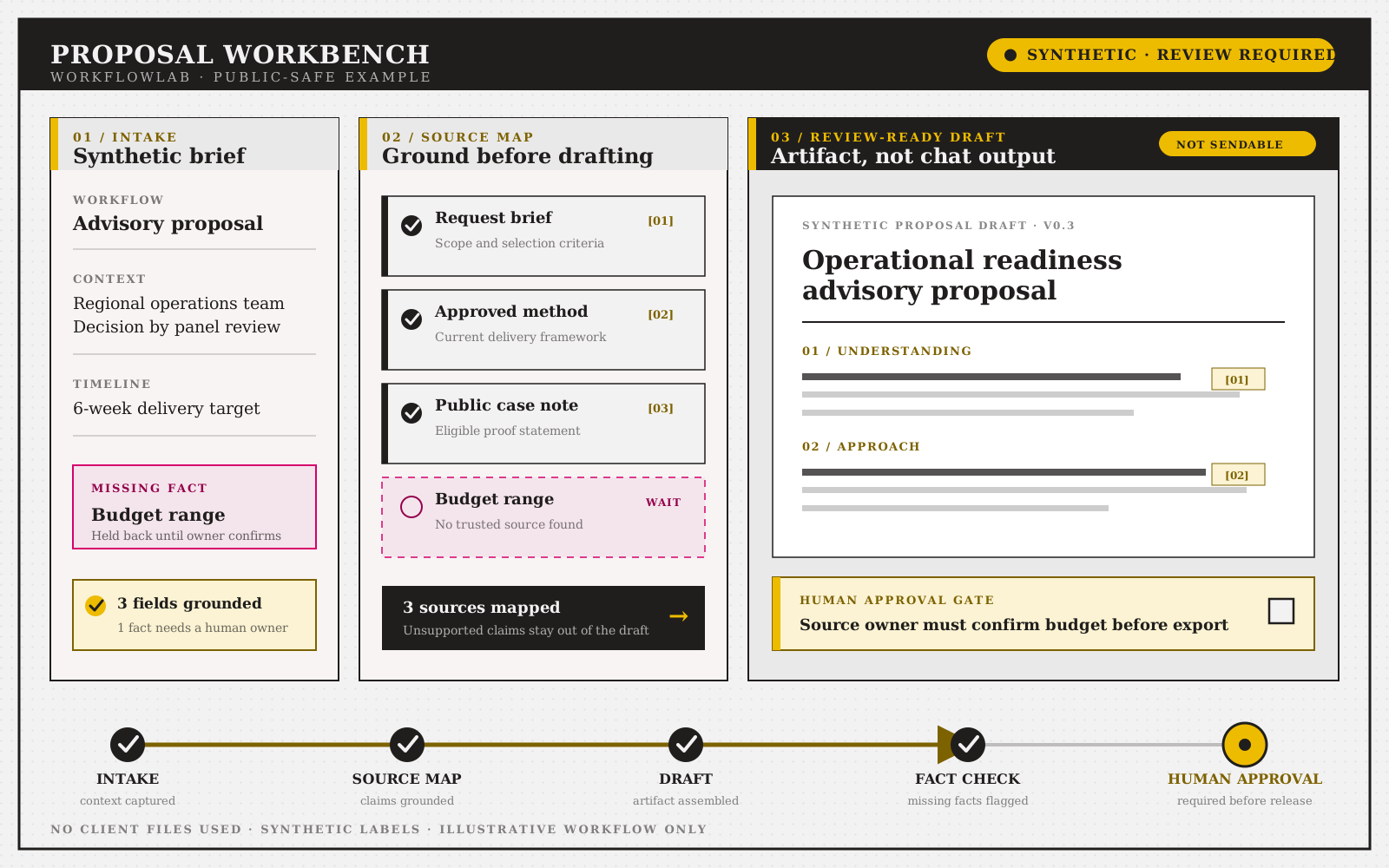
A schematic for turning a repeated workflow into something a professional can sign their name to. AI drafts, searches, extracts, compares, summarizes, or assembles. A human reviews, decides, approves, and owns the final work.

choose workflow → map process & sources → judgment gates / AI boundary → reviewable work product → first real use ⟲ improvement loop

Every node is something you can point at on a whiteboard. Nothing is hidden inside a vendor's black box.

What you walk out with — seven artifacts
  1. Workflow selection — a 1-page brief naming exactly which workflow we are touching and what we are explicitly not changing.
  2. Workflow map — a drawing of how the work actually moves today: people, files, hand-offs, bottlenecks.
  3. Source-material checklist — the inputs the artifact depends on, with privacy class, owner, and whether AI may touch them.
  4. Review-gate checklist — the questions a human asks before the artifact leaves the office. Defensible to a partner or client.
  5. AI-assistance plan — specifically where AI drafts, extracts, compares, or assembles, and where it does not.
  6. Synthetic / sanitized demo examples — worked examples on safe stand-in data so the plan is concrete, not hypothetical.
  7. First-use next step — which real piece of work it runs on next, who reviews it, and what "good" looks like.
What the free diagnostic covers

A short conversation, no obligation, no raw private client files — sanitized descriptions are fine. You walk away with: one workflow selected or rejected, the current workflow roughly mapped, the likely AI-assistance points identified, the privacy / review boundary clarified, and a recommendation — Lab, 1:1 implementation, Private Workflow Factory sprint, nurture, or no-build.

Proof — where the pattern came from
01Proposal workflow for a Big Four tax director · beta

A director-level professional in a Big Four tax practice repeatedly produces client proposals — built from the firm's master deck, a credential database, and a large amount of professional judgment, then routed through partners for sign-off.

What we built. Two passes: a web-form generator that auto-looks up the company's UEN, tax-assessment status, and GST then drafts a proposal and cover email; and a local / private assistant that assembles a near-sendable deck from the master deck and credential workbook — running locally so client data never touches a public AI service.

Where it stands. The strongest current proof of the pattern — a partner who saw it asked about rolling it out. Still beta: not yet run end-to-end on a live new proposal. Human review at every gate; partners still sign off.

02Recurring reporting for a Web3 product manager · delivered, in use

A product manager repeatedly turned scattered product material — meeting transcripts, Notion docs, Google Docs — into a decision-ready report. We set up Claude Code around his sources, mapped the report as the artifact, and taught him to run it himself. He reviews every figure and framing before it goes anywhere.

Where it stands. A report he re-runs himself instead of rebuilding — and he used it to produce the report behind his company's acquisition.

03Sales outreach package for a Web3 BD rep · delivered, reusable

The same outbound every week across Google Sheets, Apollo, Instantly, and Asana. We built a Claude Code pipeline that runs his exact stack as one repeatable workflow — find, draft, export — with his company context and voice baked in. The rep approves every message that goes out.

Where it stands. A project he re-runs instead of rebuilding: feed in target companies, get back contact lists, ready-to-send sequences, and one Instantly-ready CSV. About 90% is reusable for the next rep.

04Inbound ops automation for a member community · installed, not live yet

Near-identical signup messages every cycle. We engineered the whole workflow before any automation goes live — auto-reply, confirm, log to a shared sheet, day-of check-in list — with protected contacts, strict rate caps, a kill switch, and a week-one dry run designed in from the start.

Where it stands. Fully specified and installed on the operator's machines. Honest status: the auto-reply isn't switched on yet; the build resumes from a complete spec, not a blank page.

05Inbound DM sales bot for a sales creator · built, not live

An Instagram DM conversation engine: an eight-stage sales playbook that answers, qualifies, and moves toward a booked call — refined over five iterations, graded turn-by-turn against real conversations. The bot hands off the moment someone is ready to book or should go to a human.

Where it stands. Built, demo-deployed with full Instagram webhook integration, and evaluated against real chats — but blocked on Meta's app-review approval, never connected to the live account. A strong build, not a live deployment.

06Outbound growth engine for a membership affiliate · live, running

Reaching thousands of prospects on X — personally — plus daily awareness content. Three automated loops: one personalizes DMs from each prospect's profile, one sends on an hourly cadence with draft-then-send status tracking, one drafts awareness tweets into a human review queue. Nothing posts without approval.

Where it stands. Live and running on schedule, keeping the outreach and content pipelines full on its own.

Anonymized to industry and role. Specific examples shared on request, under NDA, after the diagnostic — nothing becomes a public case study without explicit permission.

Questions
What if my team doesn't actually have a workflow worth mapping?

Then the answer is no-build, and the diagnostic will say so. It sorts "this is worth a Lab" from "1:1 implementation" from "Private Workflow Factory sprint" from "nurture" from "don't bother." All of those are legitimate outcomes.

Do I have to share confidential client files?

No. The diagnostic works from your description of the workflow. Raw client files are never uploaded, transmitted, or required. If we eventually look at samples (typically during the Lab itself), they're sanitized first, on your machines.

Is this another "prompt engineering" workshop?

No. Prompts are downstream of the workflow. We design the workflow first — the artifact, the sources, where AI assists, where the human reviews. Prompts that survive contact with a real client artifact fall out of that design naturally. We do not sell prompt libraries.

Which AI tools do you use?

Whichever ones fit the workflow and your existing licences. The Lab is tool-agnostic — we've worked with enterprise Microsoft 365 + Copilot, a single shared ChatGPT Team seat, and fully local models on the firm's own hardware. The plan you walk out with is portable: it documents what good looks like, not which vendor produces it.

What kind of "review gate" will you actually design?

A short, defensible human-review checklist your team can run before any AI-assisted artifact leaves the office: source provenance, factual accuracy spot-check, judgment calls the human owns, sign-off owner, escalation path for exceptions. A real audit checklist, not a thumbs-up.

What if compliance blocks AI tools entirely?

We map the workflow anyway, design the review gate, and you leave with a memo describing exactly what an AI-assisted version would look like and what data classes it would touch. That memo becomes the conversation you take to compliance. Several "blocks" have turned into "approved with conditions" once the workflow and review gate were drawn clearly.

Can you implement it for us afterwards?

Optionally, yes — 1:1 implementation from US$1,500, or a Private Workflow Factory sprint for larger scopes, quoted once the workflow, source boundary, buyer, and review owner are clear. We won't sell implementation before the diagnostic — we don't know enough to scope it honestly.

What does "reviewable AI work product" actually mean?

A real version of the artifact you already produce — with the AI-assisted steps, sources, and human review gates drawn explicitly underneath it. A partner or client could trace any line back to its source, judgment call, and reviewer. That's the bar.

Book a free Workflow Diagnostic →

No raw files · no obligation · no retainer pitch · or skip it and book a US$500 founder day directly →